
INFLUENZA & COVID-19
Influenza and COVID-19: testing and treatment
We assess fever, sore throat, cough and fatigue. Symptoms, time since onset and exposure help us choose appropriate testing and treatment.
Medically reviewed by Koshiro Nishimoto, MD, PhD (Director)
Updated November 1, 2026
1. Consultation and testing
Choosing a test according to time since symptom onset
After a nurse takes your history and checks your temperature and other relevant observations, we arrange testing. At our clinic, time since symptoms began is a guide to choosing the test.
| Time since symptoms began | Usual test at our clinic |
|---|---|
| Up to and including 12 hours | IMMUNO AG antigen test with silver amplification |
| More than 12 hours, up to 48 hours | nodoca or a conventional antigen test |
| More than 48 hours | Antigen testing |
These times are a guide. The test may change according to symptoms and clinical findings. A negative result from any of these tests cannot completely rule out infection.
Video consultation to reduce infection exposure
If you arrive in your own car, testing is performed in your car, followed by a video consultation with a doctor.
If you arrive without a car, testing and video consultation are arranged in an area separate from other patients. An in-person examination is provided when needed.
IMMUNO AG in the first 12 hours
Soon after symptoms begin, the amount of virus may be low and difficult to detect with an antigen test. We use IMMUNO AG, which amplifies the detection signal with silver amplification. A nasal sample is analyzed automatically by a dedicated reader.
After 12 hours and within 48 hours: nodoca or a conventional antigen test
We choose according to symptoms, age and whether a nasal sample can be collected. Conventional antigen tests use a nasal sample to detect viral components, with results read visually.
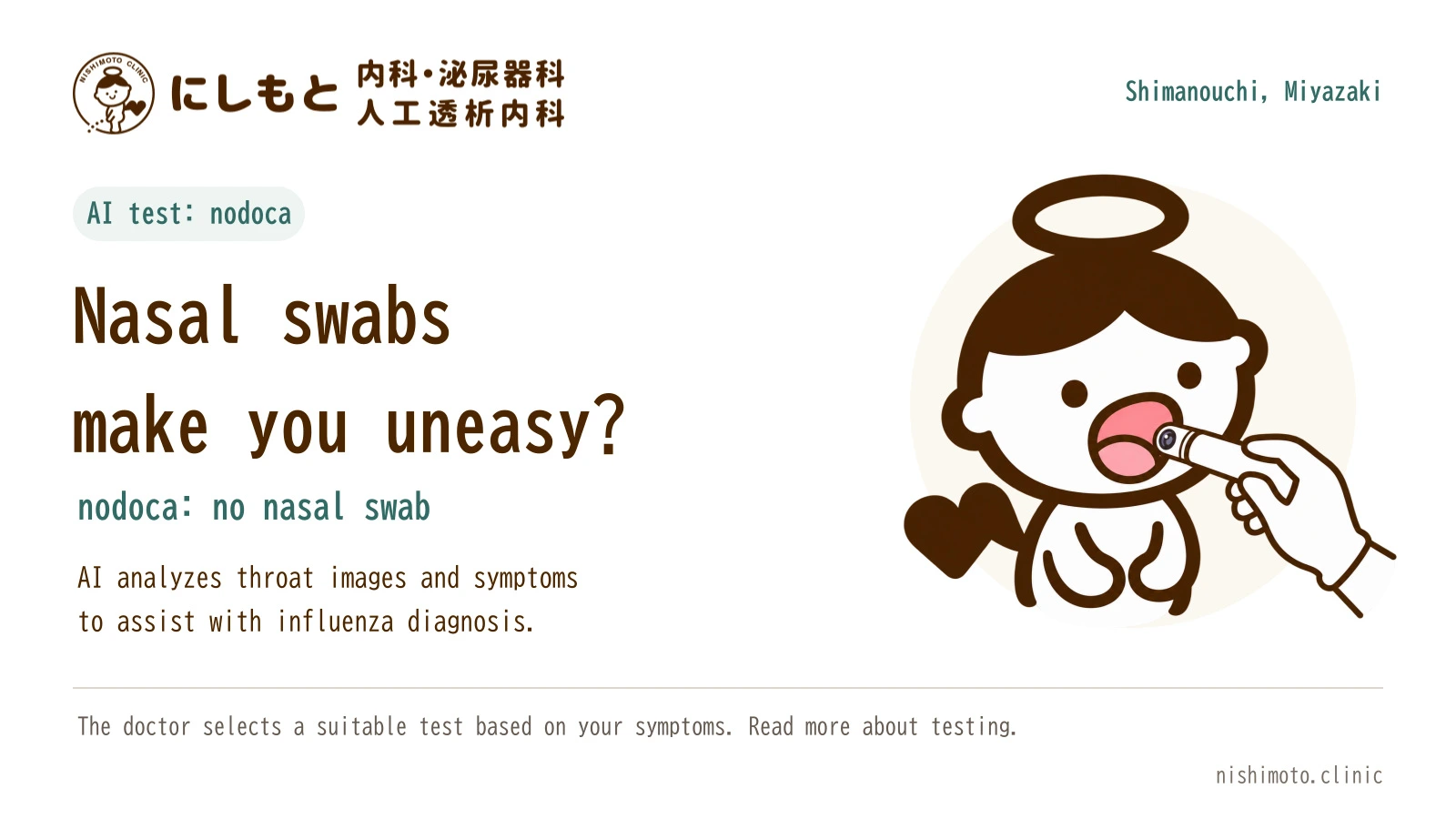
nodoca uses AI to analyze throat photographs and symptoms to assist with influenza diagnosis.
A deep nasal swab is not needed, making this an option for people who find nasal testing difficult. Once imaging and information entry are complete, a result usually appears within several to a little over ten seconds.
It also offers a COVID-19 screening function, but results are often inconclusive. When COVID-19 infection needs to be assessed, we recommend a nasal antigen test or another suitable test.
2. Treatment of influenza and COVID-19
Influenza treatment
Treatment is selected according to age, underlying conditions, pregnancy and time since symptoms began.
Influenza antivirals are generally most effective when started within 48 hours of symptom onset. Treatment may still be considered later for people at high risk or with severe illness.
- Blocks a step needed for viral gene expression: Xofluza (baloxavir).
- Limits release and spread of newly produced viruses: Tamiflu/oseltamivir, Inavir and Rapiacta.
| Medicine | Drug class | When it may be chosen |
|---|---|---|
| Xofluza / baloxavir (oral) | Cap-dependent endonuclease inhibitor | A single-dose oral treatment and a useful option particularly for influenza B. Suitability depends on age and clinical condition. |
| Tamiflu / oseltamivir (oral) | Neuraminidase inhibitor | Widely used and preferentially considered in pregnancy and severe illness. Usually taken for five days, with dose adjustment for kidney function. |
| Inavir / laninamivir (inhaled) | Neuraminidase inhibitor | For patients able to inhale the full required dose correctly. Usually given as one treatment session. Respiratory reactions need consideration in people with asthma or other airway disease. |
| Rapiacta / peramivir (intravenous) | Neuraminidase inhibitor | May be considered when oral and inhaled medicines are difficult to use. Dose adjustment is required for kidney function. We do not stock this medicine. |
Selection is guided by professional recommendations and product information. JAID 2025/26 recommendations (Japanese) / CDC guidance / Inavir label (Japanese) / Rapiacta label (Japanese)
Preventive medication for influenza
Please contact us promptly if you wish to discuss preventive medication. This is self-pay care.
Eligibility and time since exposure are assessed individually. Preventive medication cannot guarantee protection and does not replace vaccination.
Eligibility, timing and evidence for preventive medication →
COVID-19 treatment
Alongside symptom relief, antiviral treatment is considered according to age, underlying conditions and risk of severe illness.
- Blocks processing of proteins needed for viral multiplication: Paxlovid and Xocova.
- Introduces errors when viral genetic material is copied, limiting multiplication: Lagevrio.
| Medicine | Drug class | When it may be chosen |
|---|---|---|
| Paxlovid (oral) | Protease inhibitor | Considered for patients at increased risk of severe illness, including older adults and people with underlying conditions. Start within five days of symptom onset. Drug interactions and kidney function must be checked. |
| Xocova / ensitrelvir (oral) | Protease inhibitor | Considered early in illness to improve symptoms. Usually started within three days of onset. Drug interactions must be checked. Must not be used during pregnancy or possible pregnancy. |
| Lagevrio / molnupiravir (oral) | RNA polymerase inhibitor | Considered for adults aged 18 or older at risk of severe illness, for example when other treatments are unsuitable. Start within five days of onset. Must not be used during pregnancy or possible pregnancy. |
Please bring your medication record and tell us if you are pregnant, may be pregnant or are breastfeeding.
Treatment is selected using clinical guidance and product information. Japanese clinical guidance (2025) / Paxlovid label (Japanese) / Xocova label (Japanese) / Lagevrio label (Japanese)
Preventive medication for COVID-19
We do not routinely stock medication for COVID-19 prevention. Please contact us early: after confirming suitability in a consultation, we can arrange an urgent order.
Preventive medication is self-pay care. It must be started within a limited time after exposure, so supply delays may make treatment impractical.
Xocova: preventive-use conditions and product information (Japanese)
Related information
Sources are linked beside the relevant text and tables. Medical information checked on November 1, 2026.