
HPV VACCINATION
HPV vaccination9-valent SILGARD9
Cancer prevention starts before HPV infection.
- At our clinic
- Females and males of junior high school age and older
- Booking
- At least 3 days ahead
- Appointments
- Daytime and evening
Medically reviewed by Koshiro Nishimoto, MD, PhD (Director)
Updated October 21, 2026
HPV affects both females and males
Human papillomavirus (HPV) is a common virus that infects both females and males. It can cause cervical cancer and several other cancers, as well as genital warts. Vaccination is relevant to both sexes.
Vaccination before infection helps prevent future HPV-related disease. SILGARD9, used at our clinic, helps prevent infection with nine HPV types, including seven types that account for approximately 80–90% of cervical cancers.
MHLW: 9-valent HPV vaccine (Japanese)
The vaccine does not treat an existing HPV infection and cannot prevent every cervical cancer. Cervical screening remains important after vaccination.
HPV-related diseases and their frequency in Japan
The figures below show new diagnoses in Japan during each stated year.
| Disease | New cases | Year |
|---|---|---|
| Cervical cancer | 10,457 | 2023 |
| Oropharyngeal cancerTonsils, base of the tongue and nearby areas | 4,571 | 2019 |
| Anal and anal canal cancer | 1,213 | 2023 |
| Vulvar cancer | 950 | 2023 |
| Penile cancer | 525 | 2023 |
| Vaginal cancer | 382 | 2023 |
| Genital warts (warts on or around the genitals or anus) | Approx. 77,600(estimate) | 2015 |
The figures above cover annual new diagnoses of each disease as a whole; not all cases are caused by HPV. They do not represent the number of cases preventable by vaccination.
How easily can HPV spread?
You can acquire HPV even if you have had only one sexual partner.
HPV is a common virus transmitted through sexual contact. There is no single reliable percentage for the chance of acquiring HPV from one sexual encounter. Studies have examined infection over longer periods, with the following findings.
| Population and conditions | Reported estimate |
|---|---|
| Young US women who had intercourse only with their first male partner | HPV was first detected in about 29% within 1 year and about 50% within 3 years after first intercourse. |
| Young heterosexual couples in Canada in whom only one partner initially tested positive for a particular HPV type | The estimated chance of transmission of that HPV type was about 20% over 6 months after study enrolment. |
| Sexually experienced women, according to Japan’s Ministry of Health, Labour and Welfare | At least 50% are estimated to acquire HPV at least once during their lifetime. |
These figures describe different populations, observation periods and methods. They cannot be directly compared or used to predict an individual’s risk. The 20% estimate concerns transmission of a particular HPV type; it is not the chance of infection from one sexual encounter or the proportion of couples who acquire any HPV type.
Having HPV does not mean that you will develop cancer. In about 9 out of 10 cases, HPV becomes undetectable within 2 years. Some infections persist, and persistent infection with a high-risk type may lead to precancer or cancer.
How is HPV transmitted?
HPV is mainly transmitted through sexual contact involving the skin and mucous membranes. In addition to vaginal and anal sex, oral sex can transmit HPV to the mouth and throat. Genital-to-genital contact without penetration can also transmit HPV, so infection is possible even without a history of penetrative intercourse.
Can HPV be transmitted through kissing?
Some studies have found an association between deep kissing and oral HPV infection, but the risk of transmission through kissing alone is not yet clear. Kissing on the cheek and ordinary day-to-day contact are not considered usual routes of transmission.
Research on oral HPV infection / NHS patient information on oral HPV
A positive cervical HPV test does not mean that HPV is also present in the mouth or throat. The site of infection varies from person to person.
Research comparing oral and genital HPV infection
HPV can be transmitted without symptoms
HPV is a common virus, and many people do not know they have it. Infection can occur even with one partner, and a positive test usually cannot establish when or from whom it was acquired. Having HPV does not in itself mean that you have or will develop disease or cancer.
HPV vaccination coverage in Japan and four other countries
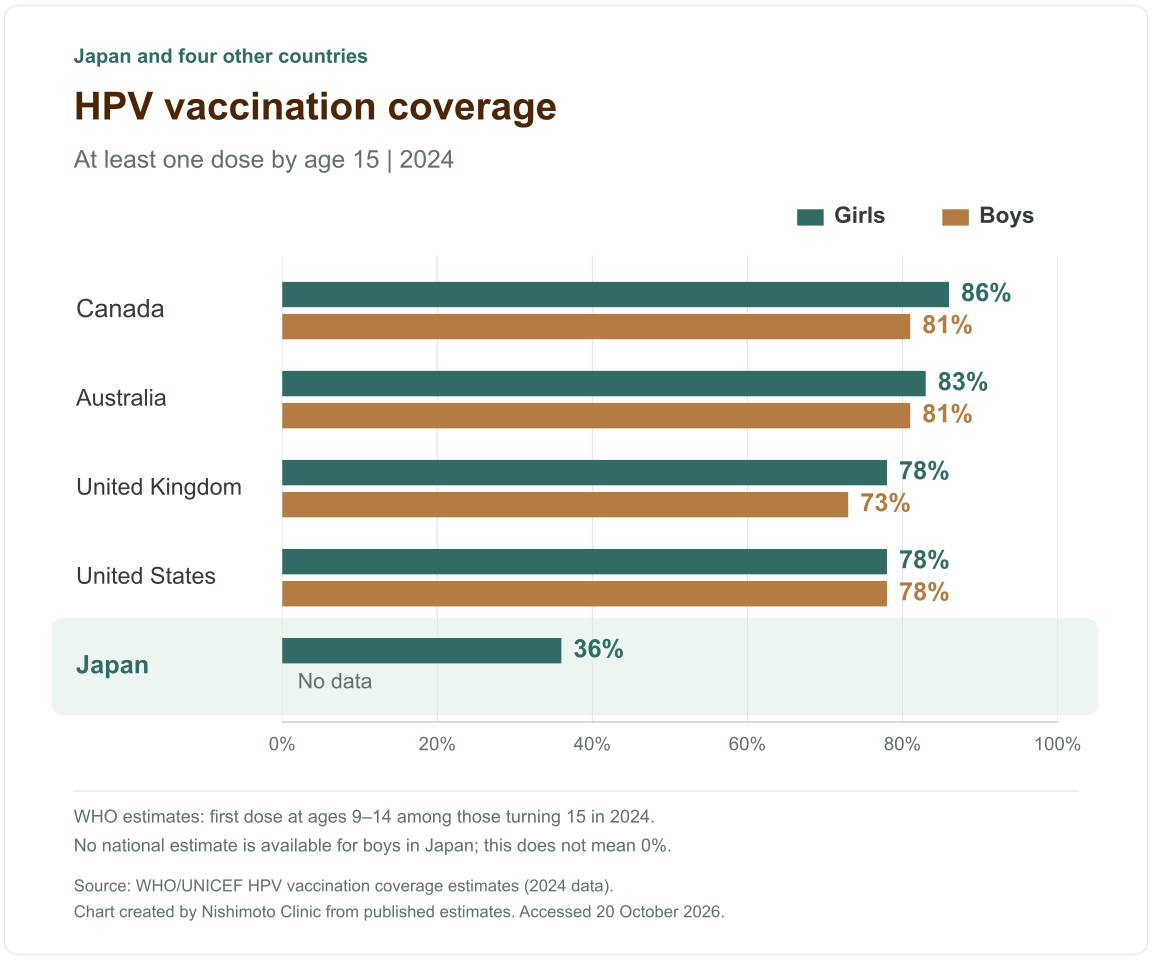
This chart compares the proportion who received at least one dose of HPV vaccine by age 15 in 2024, using the same WHO indicator for Japan and four other countries.
At least one dose by age 15 · 2024
All bars use a 0–100% scale.
- CanadaGirls86%Boys81%
- AustraliaGirls83%Boys81%
- United KingdomGirls78%Boys73%
- United StatesGirls78%Boys78%
- JapanGirls36%BoysNo data available
The cohort turning 15 in 2024, vaccinated between ages 9 and 14. No comparable national estimate is available for males in Japan; this does not mean 0%.
Source: WHO — Human Papillomavirus (HPV) vaccination coverage (2024 estimates; accessed October 20, 2026). Chart independently created by our clinic from the published values.
Underlying data provided by Canada, Australia, the United Kingdom, the United States and Japan.
HPV vaccination and cervical cancer
A Swedish observational study of approximately 1.67 million girls and women found a lower rate of cervical cancer among those who received the quadrivalent (4-valent) HPV vaccine than among those who were unvaccinated.
After accounting for differences in age, family background and other factors, the cervical cancer incidence rate was approximately 88% lower among those who started vaccination before age 17, and approximately 53% lower among those who started at ages 17–30, compared with unvaccinated participants.
These findings support the importance of considering HPV vaccination at a young age.
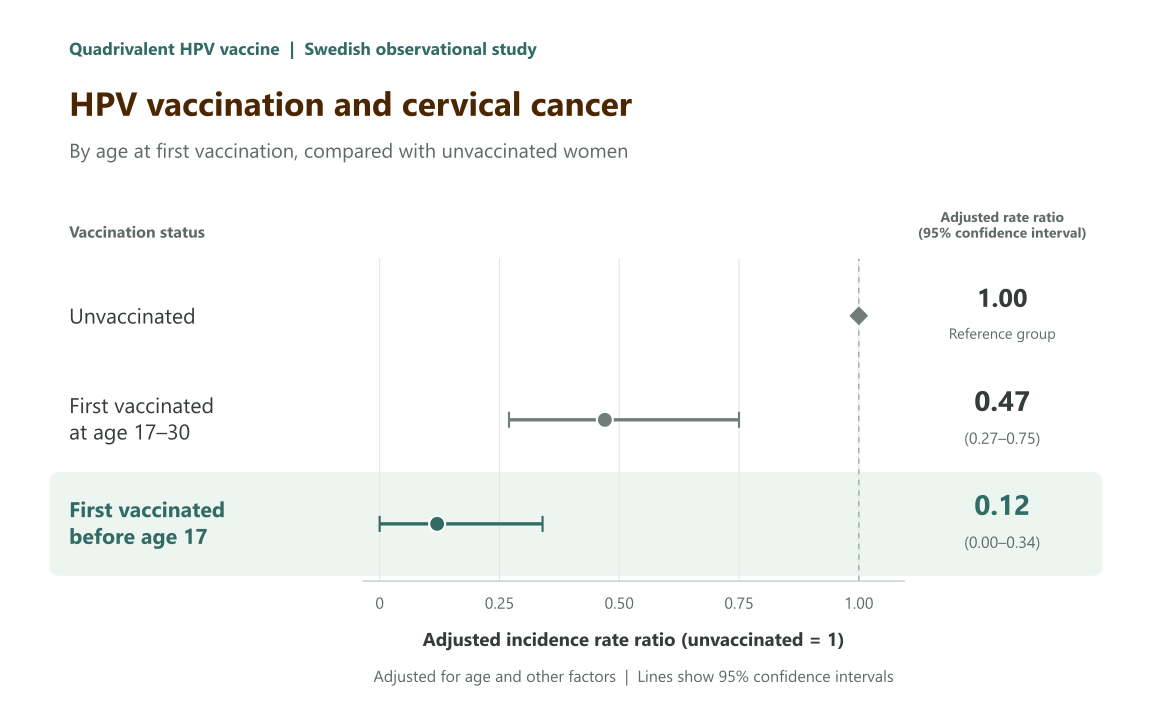
Chart created by our clinic from the numerical results in Table 2 of Lei J, et al. N Engl J Med. 2020;383:1340–1348. The published figure has not been reproduced.
Doses and timing
The number of doses depends on your age at the first dose. Each dose is a 0.5 mL injection into a muscle.
First dose before age 15
Usually 2 doses
- Dose 1Start
- Dose 26–12 months after dose 1
First dose at age 15 or older
3 doses
- Dose 1Start
- Dose 22 months after dose 1
- Dose 36 months after dose 1
For a two-dose course, if the second dose is given less than 5 months after the first, a third dose is needed. If you have already had HPV vaccine doses or missed a planned date, please bring your vaccination record so we can confirm the next dose and timing.
Fees and municipal funding
The following municipal programs cover vaccination with no out-of-pocket charge for eligible residents. Municipal eligibility starts in elementary-school year 6; our clinic accepts people of junior high school age and older.
Girls
Registered residents of Miyazaki City, Aya Town or Kunitomi Town, from Japanese elementary-school year 6 through the equivalent of high-school year 1, are eligible for routine vaccination.
Boys
Registered residents of Miyazaki City, from Japanese elementary-school year 6 through the equivalent of high-school year 1, are eligible for the city's full subsidy.
Eligibility is confirmed using your address, age and vaccination history. If you live in another municipality, please check its current program.
Daytime and evening appointments
In addition to regular daytime hours, evening vaccination is available on Mondays, Tuesdays, Wednesdays and Fridays, 18:30–21:30. Please check our calendar for changes and days without evening appointments.
Please book online or contact the clinic by phone. Bring your maternal and child health handbook or other vaccination record and a document confirming your address and age. We will explain any vaccination forms and parental consent requirements when you book.
After vaccination
Pain, redness or swelling at the injection site, headache and fever may occur. Rarely, a serious allergic reaction can occur. Please remain seated and rest at the clinic for about 30 minutes after vaccination.
Tell our staff promptly if you feel unwell. Seek urgent medical care for difficulty breathing or other severe symptoms after leaving the clinic.